 Knurl
For iPhone and Apple Watch
Get strong without having to ask.
Knurl is a barbell programme for your iPhone, from your first session onwards. It picks the weight, shows you which plates go on each end of the bar and times your rest. Anything you do not know yet is explained on the screen where it comes up.
You start with a weight you can already lift. Every cycle, a little more goes on the bar.
For iPhone, with an Apple Watch app included. No account, no ads, nothing to buy. Knurl is in beta, so this opens an email asking for a TestFlight invite, and the App Store is next.
Four lifts, and only four
One lift a session, in any order, on whichever days you can get to the gym. Each comes with a plain description and a short how-to inside the app: where the bar sits, where your feet go, what to do if a rep will not come up.
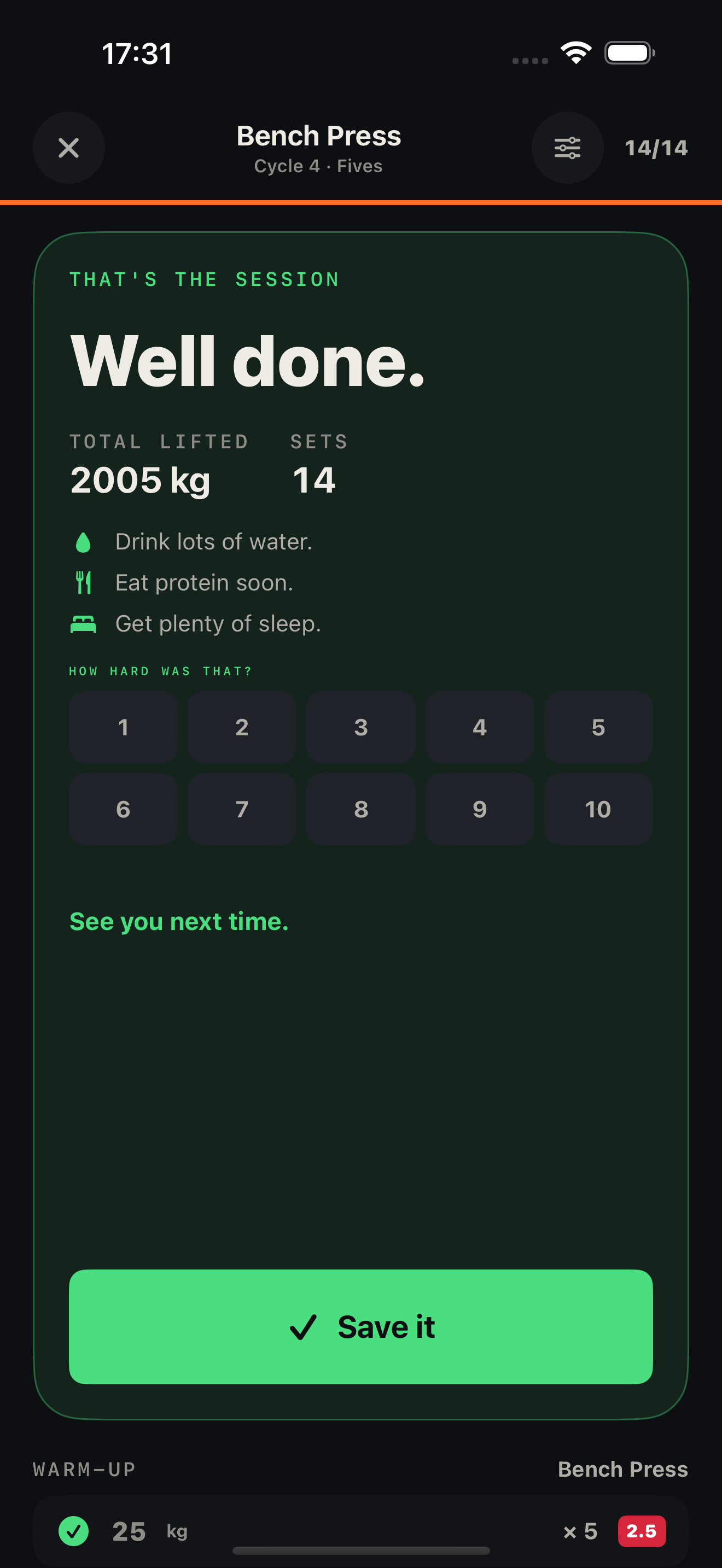
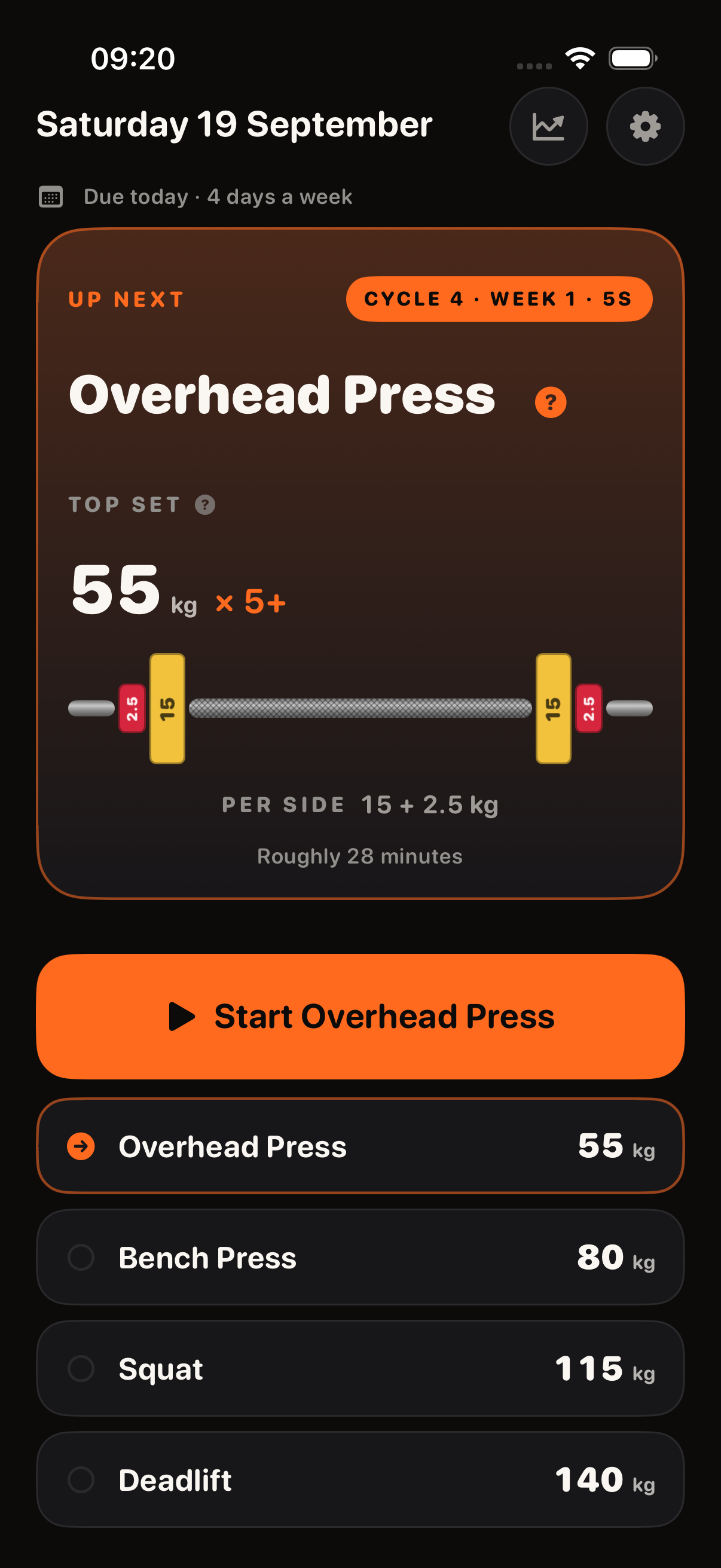
- Overhead press Standing, you press the bar from your shoulders to straight above your head.
- Bench press Lying on a bench, you lower the bar to your chest and press it back up.
- Squat The bar rests across your upper back. You sit down and stand back up.
- Deadlift The bar starts on the floor. You stand up with it and put it back down.
Fourteen gym words (top set, the + sign, working weight) have a plain explanation on the word itself, so you do not have to ask anyone.
Two things you don't need to know
What you can lift
Tell it a weight you could lift about five times, or take the light default and let it find out. The first time you do each lift it walks the weight up a step at a time, and you stop at the first set that was not easy: where you stopped is what it works from.
Everyone starts light, on purpose.
What the plates are
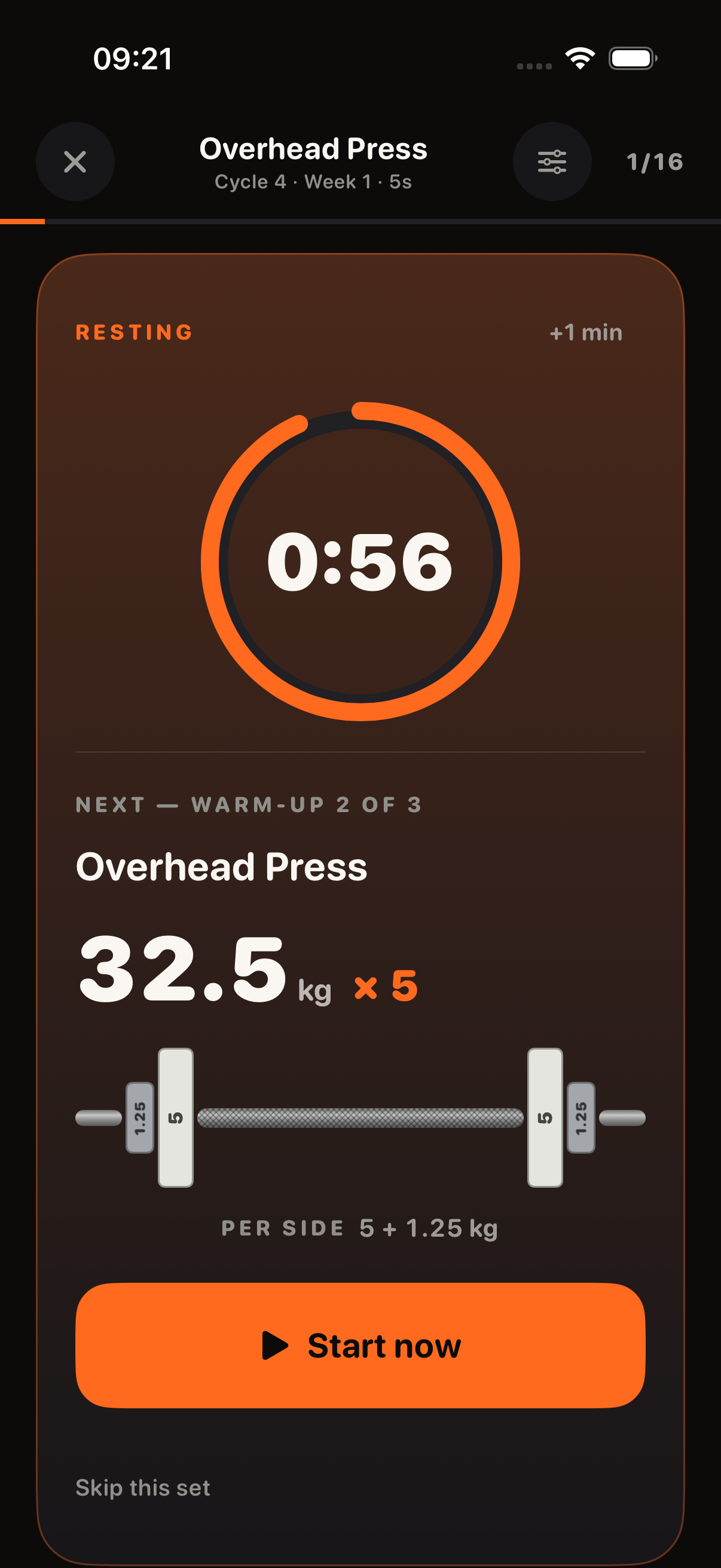
Plates are the discs that go on each end of the bar. The bar on its own is usually 20 kg, and Knurl counts it. Competition plates come in a colour code, and Knurl draws them in it even when the ones at your gym are all black.
- 25kg
- 20kg
- 15kg
- 10kg
- 5kg
- 2.5kg
- 1.25kg
You do not have to remember any of it. Every set shows exactly what goes on each side, using the plates your gym actually has.
The bar gets heavier, when you have earned it
A cycle is sixteen sessions: four lifts through four rounds. At four sessions a week that is about a month, and at two it is about two months, the same programme on a slower calendar. At the end of a cycle the weight goes up: 2.5 kg on the two presses and 5 kg on the squat and the deadlift at the standard pace, half that if you ask it to climb gently, double if you ask it to climb quickly.
-
Cycle 140kg
-
Cycle 245kg
-
Cycle 350kg
-
Cycle 455kg
-
Cycle 560kg
A squat that started at 40 kg, five cycles on. Twenty kilos heavier, every step of it earned, and there is no finish line.
- Round 1FivesThree sets of five. The last one is open: keep going for as many as you have in you.
- Round 2ThreesHeavier, and three a set. The last set is still open.
- Round 3SinglesThe heaviest round. Five, then three, then one, and as many more as you can.
- Round 4LightOn purpose. You arrive at the next cycle rested, with more on the bar.
Only when you earned it
That open last set decides what happens next. Get the reps and the weight goes up. Fall short and it stays where it is. Fall short two cycles running and it drops back. Each lift is judged on its own, so a bad week on the bench will not hold back your squat.
The bar never climbs past what you can actually lift. That is what keeps you in one piece.
In the gym
Your phone is on the floor two metres away. So every screen is one big number, one bar and one button.
- Warm-ups included Lighter sets before the heavy ones, to get you moving. Knurl sets the weight and draws the plates for those too.
- Rests time themselves The clock starts when you tick a set off. It counts down on the Lock Screen and in the Dynamic Island, then chimes when it is time to go again.
- No impossible weights Plates come in fixed sizes, so not every number can go on a bar. Knurl knows what your gym has, and when a number is out of reach it gives you the nearest one and says what it was aiming for.
- Sets on your wrist Tick a set off from an Apple Watch without picking the phone up.
- The extra work is chosen for you After the main lift there is some lighter work. Knurl picks it. You are told, not asked.
- Kilos or pounds Whichever your gym uses.
- Sessions go to Apple Health Every finished session lands there as a strength training workout, if you allow it.
Privacy
Knurl collects nothing.
There is no account and no sign-in. The app has no network code at all: no analytics, no advertising, no tracking, no third-party code. There is no server for your training to go to, and nobody here can see it. What Knurl knows about you is a file on your phone, and it goes wherever your backups go.
Six things reach past the app, all with your permission and all on devices you own:
- Apple Health. If you allow it, every finished session is saved there as a strength training workout. Knurl also reads your body weight, so it knows what a set of chin-ups is costing you. That is Apple's store, on your device rather than ours, and either direction can be turned off in the Health app.
- Notifications. Rest timers, and one reminder on the day you usually train, are scheduled by the app on the phone itself. Nothing is sent from anywhere.
- Apple Watch. With a watch paired, the set you are on and the weight on the bar go to your wrist so you can tick sets off without picking the phone up. That travels between your own two devices and no further.
- The Lock Screen. The rest countdown, the next weight and the plates are handed to iOS to draw on the Lock Screen and in the Dynamic Island. iOS draws them on your phone; there is no server pushing them.
- Your mail app. If you write to Knurl, the app hands your mail app an address, a subject and a message holding nothing but which version you are running. You write it, you read it, and you send it from your own account. Nothing about your training goes with it.
- The App Store. Once two cycles are behind you, Knurl asks iOS to show its own rating sheet. Knurl sends nothing and is told nothing: whether you rate it, and what you say, is between you and Apple. There is also a row in Settings if you would rather do it yourself.
Deleting the app deletes everything it holds.
Last updated 19 October 2026
Support
If something is broken, a number looks wrong, a word on the screen means nothing to you, or your gym has plates Knurl cannot handle, write to craig@barkingiguana.com. It goes to the person who built Knurl, and you will get a reply.